Bring Back Byzantium
Why we should dress like the Byzantium Era (again).

Skepticism immediately filled me as I clicked the “add registration” button for an Art History course at my local college. I had been hoping to continue my academic pursuit.
Why the skepticism?…You may ask. Well, let’s just say local public colleges these days are notoriously known for agendas, emotive movements, and subjective thinking…especially when it comes to art.
However, I thought I’d give it a shot. To my surprise, I have quite enjoyed it so far. Currently, we are learning about Byzantium History…specifically the clothing that was worn.
As I was scrolling through the photographs on my assigned article today I was taken aback. So that you can understand my reasoning behind why we should dress Byzantium again, I must tell you of an endeavor I have been pursuing. A style change. A complete, upturn of the closet. Old clothes out, the beloved shirt of 2021 off to goodwill, and a revamping.
Style is quite a fun thing to explore. More recently, I have come to a mature view of it. To an extent I am dressing like others— in the sense, that if I have a business meeting, or I am teaching a class, I am going to dress professionally. Or, if I am about to climb a very large hill with a group of friends, I am definitely not going to wear a dress.
On the other hand— we all wear different clothes but with the same commonality that: everyone is wearing a piece of clothing that is “in” or has once been “in.”
Think back to the 2006 film Devil Wears Prada. Head designer Miranda (played by Meryl Streep), is choosing pieces for the newest campaign. That is until assistant secretary Andrea (played by Anne Hathaway) comes in, laughing under her breath that Miranda has chosen what appear to be the exact same two shades of blue for the wardrobe. Defensively, Miranda goes on what might be fashion’s to be or not to be Hamlet monologue. Click on the link to watch the scene (please do it so you understand my point)…
If you have not seen Devil Wears Prada it is a well made film, one I have seen a few times. The more I have watched this scene in particular, the more it has made me think about the history of fashion— and how when we minimize clothing to practicality, or even at times a spit on materialistic endeavor. I fear that when we minimize fashion to such degrees we do a disservice to the artistry it has provided humanity for thousands of years.
I would like to clarify, in no way am I promoting a vain, materialistically self obsessed striving for stylistic fahsion, in fact I hope this article provides quite the opposite.
As a Christian, it is my firm belief that we should be doing everything with intention, knowing that ultimately what we do is bringing glory to God.
1 Corinthians 10:31, ESV.
31 So, whether you eat or drink, or whatever you do, do all to the glory of God. 1 Corinthians 10:31.
That said, I am so grateful that wether I am eating, drinking, talking, writing, or choosing clothes to wear, I am enabled through the Holy Spirit to do it all to the glory of God.
Now jump with me back to today. I thoroughly enjoyed the article I read. I was in awe that the pieces made during the Byzantine empire, were pieces common workers, emperors, Christian religious leaders wore. Pieces were made under Christendom in desire to bring glory to God. Beautiful pieces were worn as artistry. People would carry with them elaborate crosses, traditional family pieces, robes of beauty created in a modest—yet pleasing to the eye fashion. What most of this clothing was representing was an attempt to display appreciation for the beauty and splendor of our Lord.
It is my firm belief that when people are recognizing the Lord and desiring that He be displayed first, the response becomes a creative one. This is true across time—and not just subject to clothes.
Thinking simply— dinners. Beautiful dinners, candles are lit, poetry and hymns are read and sung, people are dressed in appreciation. There are many mentions of feasting on earth and heaven in the Bible, and the link that makes it so grand is the act of giving glory to God, thanking him for such provision in food and community.
On the other hand— songs being created. Amongst several of Elvis Presley’s albums there is a collection of gospel songs. As to the state of Elvis’ life I hope the Lord revealed himself to Him! The product of these songs created a blue grass, velvety collection of hymns that have been admired, and mass produced around the world. This creative response is not just subject to Elvis. Gospel set to song is happening daily by many secular and Christian musicians.
To these examples I ask, should not our act of wearing clothing be the same showing of appreciation to our Lord?
So often, I find lack of quality in pieces. I am overwhelmed by the fast fashion industry, and how it seems that we continue on buying into such evil. I see young women dressing to bring down the gaze of appreciation for God to a lustly appreciation upon themselves. I also see people not caring about how they dress—they show up to class in pajamas.
To an extent what we wear reflects our view about ourselves and the world around us.
On another note—Christian or not, many people want to escape “people pleasing” in what they wear. That’s why we often observe people trying out a crazy hair dye, wearing something completely outlandish, or just ‘fitting in’ so to speak.
However, this attempt of not pleasing people, can easily turn into an attempt to please ourselves.
So I guess, I am convicted and also brought to a place of excitement. How often do I make what I wear about others or about myself?
Do I ever put on clothing and say is this God honoring? Is this reflective of the beauty and splendor that I have been invited to share through Christ?
The Byzantines asked this question, and the result was some of the most beautiful pieces of clothing and jewelry ever created. Now these pieces are on display in the Met and the Louvre (to name a few major museums). Some have even influenced fashion today, the fitted wrap shirt/dress, the pearl earrings and beaded bracelets— staples us ladies often wear.
I for one in my style change definitely want to embrace the Byzantine fashion— specifically the motive behind it, and by the look of who my subscribers are, I think you guys would too. :)
I don’t have much else to say on this…except maybe go checkout these pieces online. I hope that this prompts you into more appreciation, that every good gift is from God, and He uses even the things our modern culture taints to bring glory to Himself.
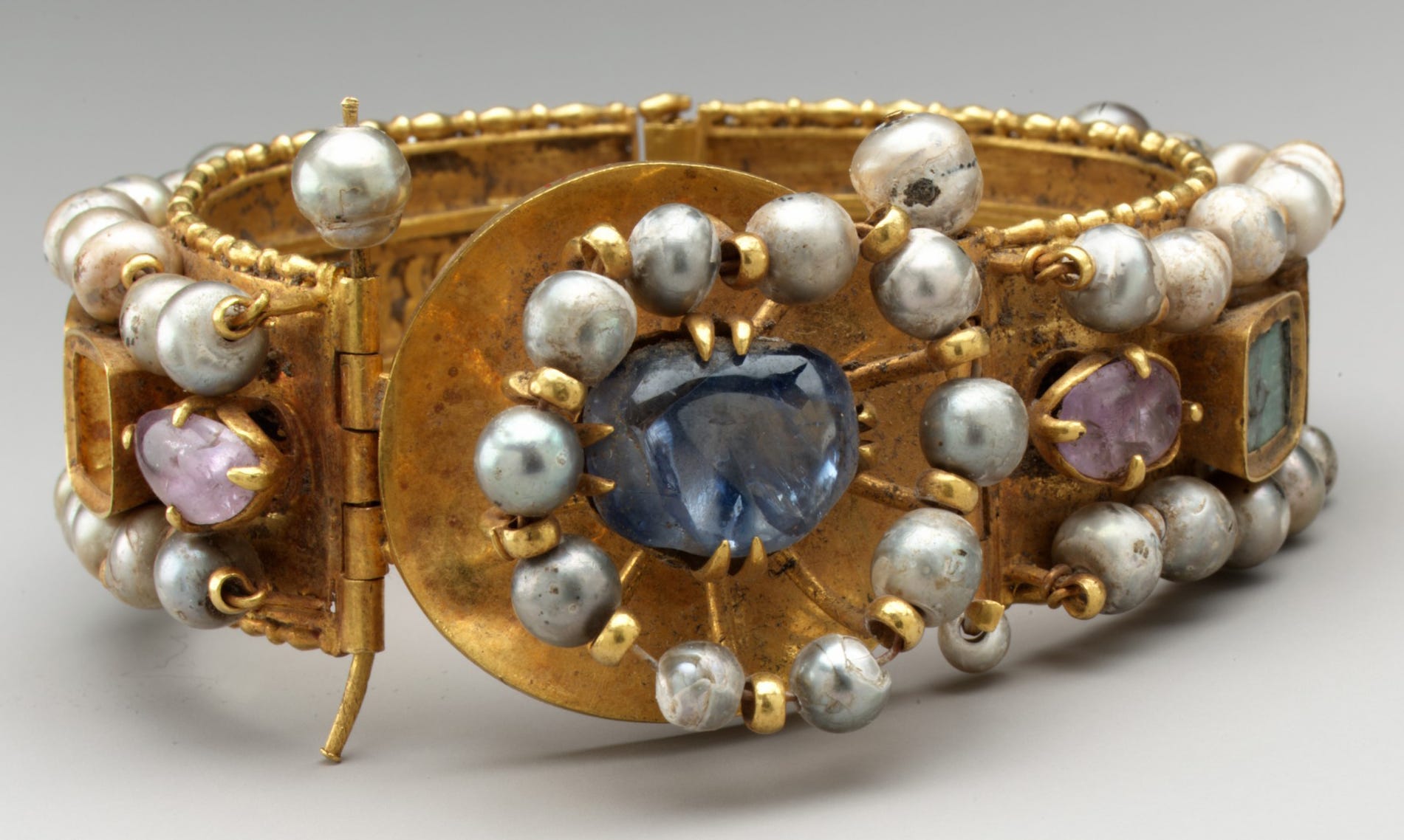
Stunning photo of a bracelet piece from Smarthistory.org below…
“Bracelet, early Byzantine, 500–700, Constantinople (?), gold, silver, pearl, amethyst, sapphire, opal, glass, quartz, and emerald plasma, c. 4 x 8 cm (The Metropolitan Museum of Art)” (Smarthistory.org).
P.S. some homework… Find your favorite piece, and if you want—leave a comment so I can see which Byzantine piece you love!